

 InfoSearched
EarthRoamer just rewrote what a four-wheel-drive luxury camper can be built from.
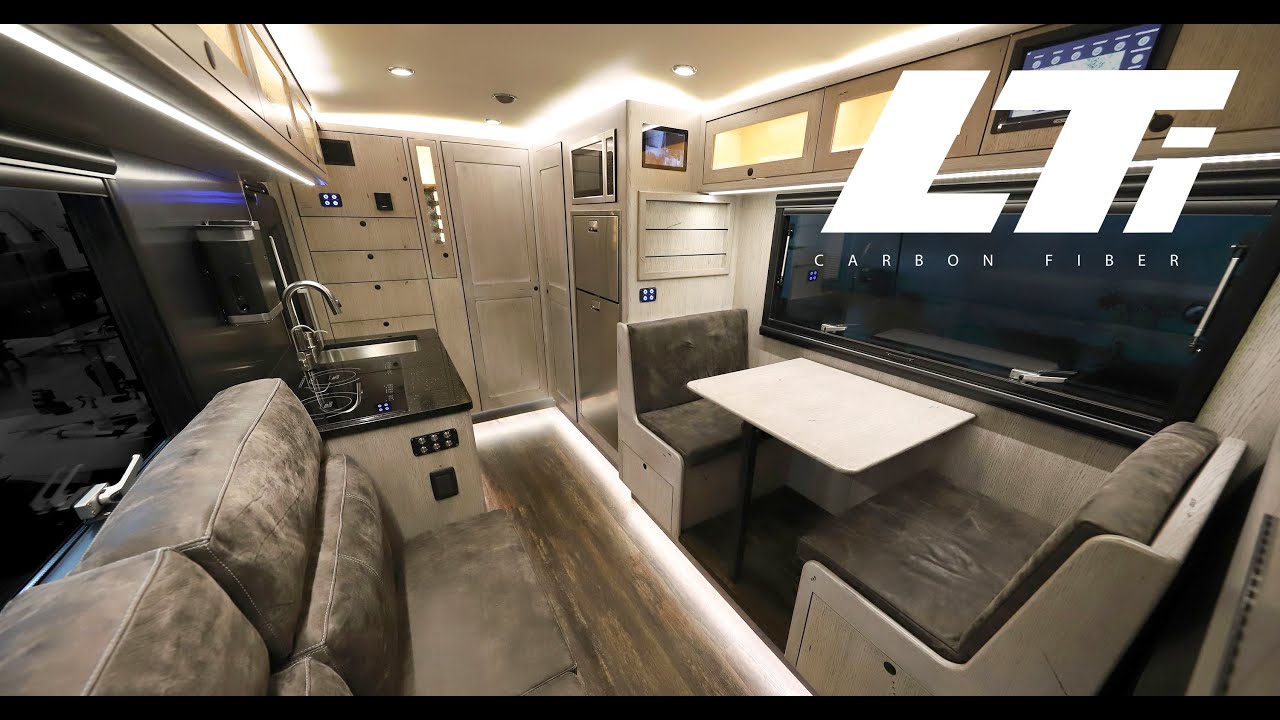
EarthRoamer’s interior walkthrough of the new LTi pulls back the curtain on the successor to the company’s long-running LTS, and it’s not a mild refresh. The Dacono, Colorado-based builder swapped its traditional metal-framed camper shell for a one-piece carbon-fiber monocoque, then loaded the cabin with the kind of residential fixtures — granite counters, a rainfall shower, induction cooking — that most overland rigs simply can’t fit or power off-grid.
The walkthrough treats the LTi as both an engineering demo and a livability pitch: this is a truck meant to run without propane or a generator running through the night, parked somewhere with no hookups for days at a time.
- The LTi is built on a four-wheel-drive Ford F-550 Lariat Crew Cab chassis powered by a 6.7-liter Power Stroke V8 turbo-diesel paired with a 10-speed automatic transmission.
- Its camper body uses a Vacuum Infusion Process that bonds two carbon-fiber skins to a structural foam core, creating a seamless monocoque with no metal framing or roof seams — cutting weight while adding interior headroom and insulation.
- Power comes from 1,320 watts of roof-mounted solar, dual inverter/chargers, and a 20,000-watt-hour lithium-ion battery bank with an auto-charge system, supporting off-grid living without propane or a generator.
The Chassis and the Carbon-Fiber Breakthrough
Underneath everything is a Ford F-550 Lariat Crew Cab, four-wheel drive, running the 6.7-liter Power Stroke V8 turbo-diesel through a 10-speed automatic. That’s a familiar, serviceable platform for anyone who’s followed EarthRoamer’s XV line. What’s new is what sits on top of it: a camper body built through a Vacuum Infusion Process that bonds two carbon-fiber skins around a structural foam core into a single monocoque shell.
That construction eliminates the traditional metal framing and roof seams that have defined expedition campers for decades. The payoff is lighter weight, noticeably better thermal insulation, and enough extra headroom inside to stand up straight without ducking under a ceiling brace — a small detail that matters after a few weeks of full-time living in the rig.
A Galley Built for Off-Grid Cooking
The kitchen inside the LTi doesn’t look like a camper galley. EarthRoamer went with granite countertops, an induction cooktop, a deep stainless-steel sink with a touch-activated faucet, a securely mounted coffee maker, and custom cabinetry throughout. None of it runs on propane, which is the point — the whole system is designed to function entirely off the vehicle’s electrical bank.
A 20,000-watt-hour lithium-ion battery bank paired with 1,320 watts of rooftop solar and an auto-charge system keeps the LTi running without propane or a generator.
That battery capacity is the number that separates the LTi from a typical overland build. Dual inverter/chargers manage the load, and the whole electrical system is monitored through an advanced digital touchscreen control panel, giving owners a real-time read on power draw, water levels, and charging status wherever they’ve parked.
Living Quarters and the Wet/Dry Bathroom
The cabin layout leans on flush-mount frameless glass windows and dedicated bunk side windows over the cab, which open up sightlines that older EarthRoamer models didn’t have. A convertible dinette handles seating and sleeping duty, and optional floorplans stretch capacity to seating and sleeping for up to six people.
The bathroom is full-height, with a wet/dry layout that includes a rainfall shower and a cassette toilet — a setup built for multi-season use rather than a quick weekend loop. An expanded cab-to-camper pass-through ties the driving compartment to the living space, while high-capacity fresh and grey water tanks extend how long the rig can sit off-grid before needing a refill.
Functions Replaced by LTi
EarthRoamer positions the LTi as the direct successor to the LTS, carrying over the brand’s core promise of self-contained, luxury off-grid living in a rugged four-wheel-drive platform while pushing the build quality forward with the carbon-fiber monocoque. Anyone who’s toured a comparable off-grid expedition build, like the custom off-grid expedition yacht featured in a recent walkthrough, will recognize the same design logic here — heavy investment in self-sufficiency systems instead of relying on shore power or a fuel-hungry generator.
EarthRoamer builds every LTi by hand in Dacono, just north of Denver, which puts the factory practically in the shadow of the terrain these trucks are meant to handle — the same stretch of Rockies covered in this summer’s Colorado mountain travel vlog. For a rig with a 20,000-watt-hour battery bank and a cassette toilet instead of a black tank, that’s not a coincidence — it’s the proving ground.







Hawaii 2017 – A Trip Through Paradise
College Student Builds Outstanding DIY $15,000 Tiny House For Debt Free Living
Foreigners SHOCKED in PUERTO GALERA – Big La Laguna Beach (Travel Philippines)
Shanghai Travel Guide
THE 2 MOST BUCKET LIST THINGS TO DO IN ZANZIBAR. Ultimate African Adventures!