

 InfoSearched
An island half the size of London, with no room left to spare, decided to build straight up and straight out.
National Geographic’s City of the Future: Singapore spends 45 minutes inside a city-state that had no choice but to innovate. Released free on YouTube on November 24, 2018, and produced by Beach House Pictures in partnership with Singapore’s Ministry of Communications and Information, the film is directed by Dylan Reibling and narrated by Singaporean actor Adrian Pang. It tracks how a nation of 5.7 million people, packed onto land smaller than Metropolitan London, has spent the decades since its 1965 independence engineering its way around scarcity.
- Singapore, home to 5.7 million residents on roughly half the land area of Metropolitan London, has relied on land reclamation, smart public housing, and exploration of air rights to stretch its limited footprint.
- Entrepreneur Benjamin Swan is featured growing food in high-tech indoor environments with no soil and no direct sunlight, part of the country’s push toward food self-sufficiency.
- The documentary also covers Singapore’s efforts on water scarcity, zero-waste systems, green-space integration, diabetes among an aging population, drone technology, fintech, and its startup ecosystem.
Building Where There Is No Land Left to Build On
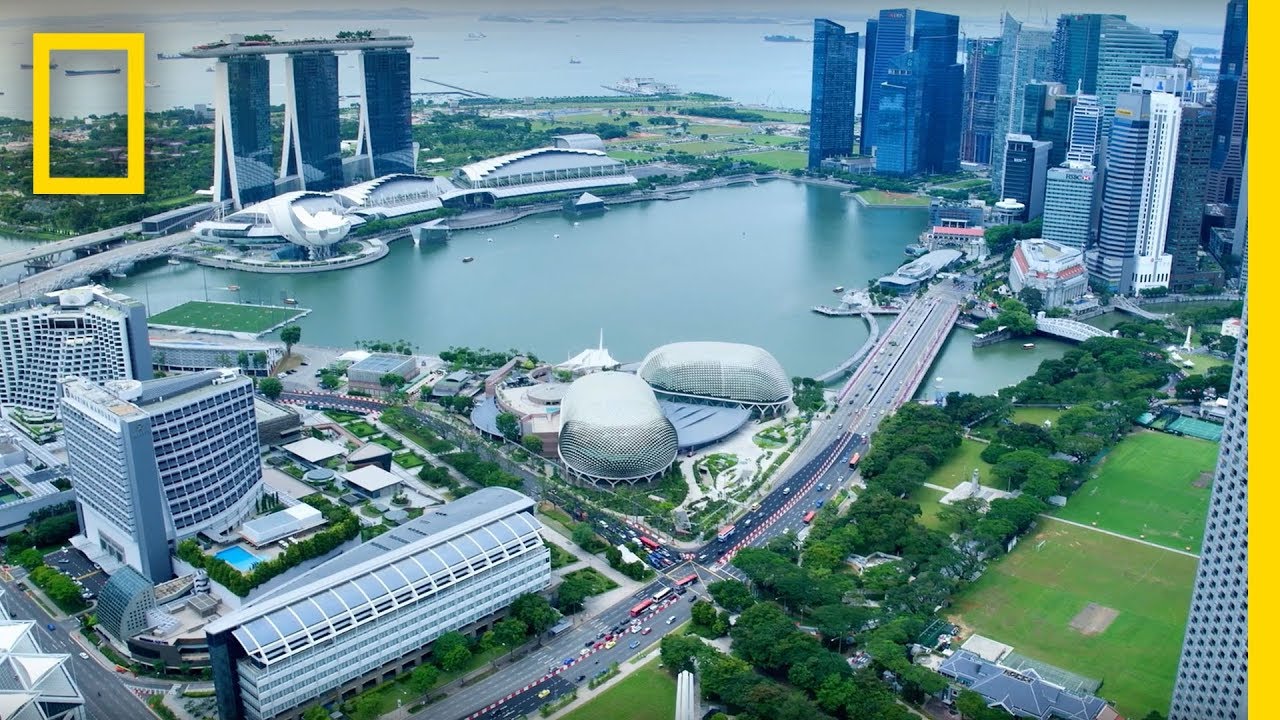
Singapore’s fundamental problem is geography — there simply isn’t much of it. The documentary lays out how the government has answered that with land reclamation projects that have physically expanded the island’s coastline over decades, paired with high-density public housing designed to house the bulk of the population efficiently. Planners are also examining air rights, effectively treating the space above existing structures as developable real estate in a country that ran out of ground-level options long ago.
What comes through in the film is less a single dramatic fix than a pattern: Singapore treats land itself as infrastructure to be engineered, not a fixed constraint to work around. That mindset recurs across every sector the documentary visits.
Growing Food Without Soil or Sun
One of the film’s clearest illustrations of that mindset is entrepreneur Benjamin Swan, who appears producing food inside high-tech indoor facilities that use neither soil nor direct sunlight. For a country that imports the overwhelming majority of what it eats, indoor and vertical farming isn’t a novelty — it’s a hedge against a food-security problem that land scarcity makes almost impossible to solve any other way.
A city-state that imports most of its food is now growing it indoors, without soil, without sunlight — because it has run out of other options.
Water, Waste, and Green Space Under Pressure
The documentary turns next to Singapore’s resource-management playbook, addressing chronic water scarcity alongside zero-waste initiatives and deliberate green-space planning woven into urban developments. None of these challenges are treated as separate problems in the film — they’re framed as different facets of the same equation a small, dense, resource-poor island has to keep balancing as its population grows.
Health, Drones, and a Startup Economy
Beyond infrastructure, the episode widens its lens to Singapore’s public-health and technology sectors. It examines healthcare strain from rising diabetes rates in an aging population, alongside the country’s advances in drone technology, its fintech sector, and a startup ecosystem the film presents as evidence that the same long-term, no-shortcuts planning philosophy extends into how Singapore builds its economy, not just its skyline.
Visually, Reibling leans on sweeping drone footage of Singapore’s architecture cut against animated explainer sequences that break down the mechanics behind each innovation — a structure that lets the documentary move between sectors without losing the thread of what ties them together: a country with almost no natural slack, engineering its own margin.
For anyone who’s flown into Changi and wondered how a city this small runs this efficiently, or who’s compared it to the sprawl of somewhere like the Shanghai region across the water, this is the 45 minutes that explains the planning behind it. Swan’s indoor farms and the country’s air-rights experiments are the two details worth remembering — they’re the clearest signs of a place that stopped waiting for more land and started making its own.









10 MINI CAMPER TRAILERS | AMERICAN MADE and UNDER $10,000 | 2020 – 2021
Abandoned 6 -Star Resort in Thailand – S3E02 vlog
Wilderness Resort Tour Wisconsin Dells Water Parks and Theme park
EarthRoamer LTi Interior Walkthrough
Travel With Me In Oman!