

 InfoSearched
A hotel bolted to a cliff face 1,200 feet above Peru’s Sacred Valley is exactly as wild as it sounds.
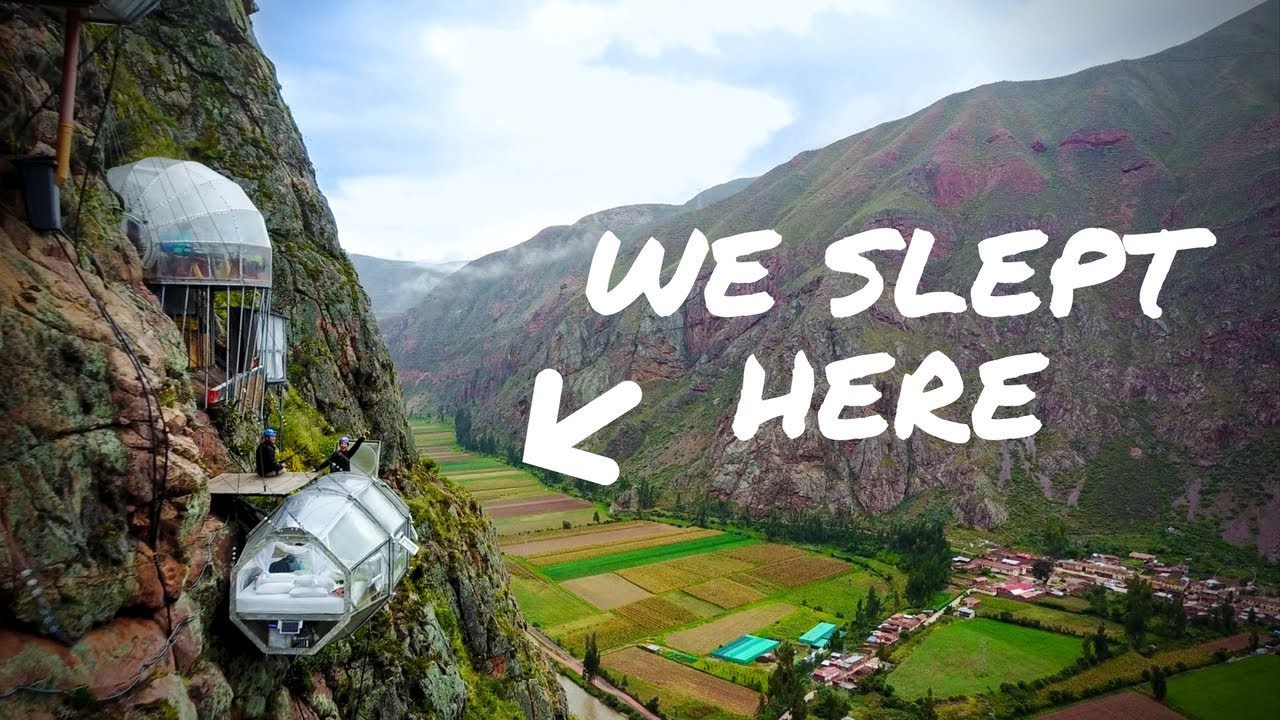
In “WE SLEPT ON THE SIDE OF A MOUNTAIN | Peru Sky Lodge,” travel vloggers Kara and Nate check off a bucket-list stop that’s been on their radar for years: a night inside the Natura Vive Skylodge Adventure Suites, a set of transparent capsules hanging off a rock face near Urubamba. There’s no elevator, no road, and no easy way in — guests either climb up or zipline in, and either way, they sleep suspended 400 meters above the canyon floor.
- The Skylodge sits 1,200 feet (400 meters) above Peru’s Sacred Valley near Urubamba, opened in June 2013, and was conceived by climber Ario Ferri and manager Natalia Rodriguez, modeled on climbers’ hanging portaledges.
- Guests reach the pods by climbing a 400-meter via ferrata route of steel rungs drilled into the cliff, or by hiking a trail and finishing with a zipline sequence.
- The capsules are built from aerospace-grade aluminum and weather-resistant polycarbonate, rated to hold 21 times the weight of five people, and descent the next morning runs across a network of six ziplines stretching 100 to 500 meters back to the valley floor.
Getting Up the Mountain
Nobody drives to the Skylodge. Guests pick one of two entry routes: a straight via ferrata climb up steel rungs bolted into the rock for 400 meters, or a hike combined with a zipline run across the canyon. Kara and Nate document the climb option in the video, harnessed in and clipped to a fixed line the entire way up, guided by bilingual mountain guides who handle the technical sections. It’s the same style of route climbers have used for decades on portaledge ascents — Ferri built the whole concept around that gear.
The overnight package bundles round-trip transport from Cusco with all the climbing equipment, the guides, breakfast, and a multi-course dinner served with wine. Anyone who’s tried a via ferrata elsewhere, or worked through a long trail like the one covered in Hiking 40 Miles Alone on the Trans-Catalina Island Trail in California, knows the appeal of exposed rock routes — this one just ends with a glass box hanging off a cliff instead of a campsite.
Sleeping in a Glass Capsule
Each capsule measures 24 feet long and 8 feet high, kitted out with solar-powered lighting, four beds, a dining area, and a private bathroom with a dry ecological toilet and a sink positioned to overlook the valley. Entry and exit happen through top-mounted escape portals, and guests stay clipped into safety harnesses the whole time they’re inside — there’s no walking around outside the pod once it’s dark.
Four beds, a dining table, a toilet with a view, and 400 meters of open air underneath the mattress.
It’s a different flavor of compact-space travel than what shows up in something like What a Japanese Capsule Hotel is Really Like — same basic idea of sleeping in a sealed pod, but swap out a stacked hallway in Osaka for a sheer drop into the Sacred Valley.
Dinner, Wine, and the Descent
Dinner happens in a separate dining module bolted alongside the sleeping pods, where the multi-course meal and wine service round out the overnight package. The next morning, there’s no climbing back down — guests navigate six ziplines ranging from 100 to 500 meters across the canyon, each one dropping them closer to the valley floor until the trip ends back where the road actually reaches.
Kara and Nate’s video runs through the whole sequence — the climb up, the night in the pod, the ziplines out — the same overnight loop Natura Vive has run since the lodge opened in 2013. For anyone chasing the booking after watching, the capsules only sleep small groups at a time, so the calendar fills up fast during Peru’s dry season.


EXPLORING ST. GEORGE, BERMUDA | TOBACCO BAY BEACH | TRAVEL VLOG
Discovering Valletta : Malta European capital of culture 2018 | travel with children | family travel
CLIFF JUMPING & CAVE EXPLORING AT ADMIRALTY HOUSE PARK
Road trip & Things to do in Quebec, Canada (Great Trail & Outdoor activities)
We Tried the FINNISH SAUNA (rolling in the snow)